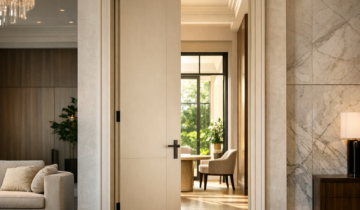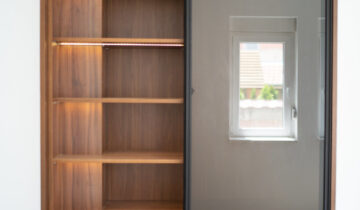
In warm minimalist interiors, matching interior door finishes with metal accents is less about making everything identical and more about creating a calm, edited material palette. The door, its hardware, nearby trim, and surrounding surfaces should feel related, even when they are not exact matches. That balance is what gives a room visual continuity without flattening it.
Why door finishes matter more in warm minimalism
Warm minimalism depends on restraint, but restraint does not mean blandness. Because the palette is often built from stone, wood, plaster, and muted paint colors, the door becomes a structural part of the composition rather than a background detail. A poorly chosen finish can interrupt the rhythm of the room, while a thoughtful one can make the architecture feel more intentional.
This is especially true in open-plan homes, hallway transitions, and spaces where flush or nearly flush doors are used to preserve clean sightlines. When the finish aligns with the rest of the interior, the door reads as part of the wall plane instead of a separate object.
How to match interior door finishes with metal accents
The most successful approach is to think in terms of finish families. A walnut veneer door, for example, does not need a mirror-finish brass handle to feel elevated. It may look more refined with brushed bronze, dark bronze, or a softly reflective blackened metal that respects the warmth of the wood.
Start with the dominant finish family
Ask which material leads the room. If the interior is anchored by oak, walnut, or travertine, the door finish should support that warmth rather than compete with it. If the space relies on lacquered panels, lighter plaster walls, and slim bronze details, the metalwork may carry more visual weight. The goal is to establish hierarchy, not uniformity.
For examples of how different door styles and surface treatments can influence a room, browse the LuxuryInteriorDoors catalog.
Use sheen to control contrast
Sheen level is often more important than color family. A matte or satin door finish feels quieter and more architectural, especially in warm minimalist homes. High-gloss finishes can work in luxury interiors, but they tend to read as more expressive and require stronger surrounding support. Metal accents should follow the same logic. A brushed or antiqued metal usually feels more integrated than a highly polished surface, especially when the door itself is meant to recede.
Coordinate hardware, trim, and surrounding materials
Door hardware is the smallest detail with the biggest influence. Handles, hinges, flush pulls, and rosettes should relate to nearby lighting fixtures, stair rails, cabinetry pulls, or plumbing trims when possible. That does not mean every metal element must be identical. In fact, a room often feels more sophisticated when one finish leads and the others support it.
- Walnut or dark wood doors: Bronze, graphite, or blackened metal tends to create depth.
- Light oak doors: Soft brass, champagne bronze, or muted nickel can keep the palette warm without heaviness.
- Painted or lacquered doors: A restrained metal finish can provide definition without breaking the wall surface.
Trim also matters. If the baseboards and casing are crisp and architectural, the hardware can be slightly more expressive. If the room is already visually active through stone veining or strong timber grain, the metal details should be quieter.
Finish combinations that feel intentional
Some combinations consistently work because they preserve balance between warmth, contrast, and material continuity. A few examples stand out in contemporary residential design:
- Walnut with bronze hardware: rich and grounded, especially in living areas and private suites.
- Oak with brushed champagne metal: soft, luminous, and well suited to daylight-filled interiors.
- Matte lacquer with blackened hardware: crisp and architectural, particularly in minimalist corridors.
- Stone-toned doors with subtle brass accents: refined when the room already has strong texture.
If your project leans toward concealed or wall-integrated door systems, the finish decisions become even more important because every visible line matters. In that setting, a more architectural approach can help the door disappear into the surface plane while the hardware provides just enough definition. For projects that call for this level of integration, custom interior door applications from DAYORIS can offer a useful design reference for how doors participate in a larger architectural composition.
Common mistakes to avoid
The biggest mistake is overmatching. A bronze handle, bronze hinge, bronze light fixture, and bronze decorative object in the same line of sight can feel forced rather than coordinated. Another common issue is ignoring undertone. A cool silver metal against a highly warm wood finish can work, but only if the contrast is deliberate and supported by other cool elements in the room.
It is also easy to overlook proportion. A slim handle may disappear on a large door surface, while an oversized pull can overpower a restrained interior. In luxury interiors, scale should feel measured. The best finish choices are the ones that make the door feel quiet, balanced, and architecturally resolved.
For broader design inspiration, the LuxuryInteriorDoors blog explores how doors influence movement, light, and spatial rhythm in premium interiors. That broader context matters, because finish selection is never only about color. It is about how the door participates in the room, how the metal catches daylight, and how the entire envelope feels when you move through the house.
If you are planning a renovation or new build, start by identifying the dominant material, then choose the door finish and metal accents as part of one visual system. When the proportions, sheen, and undertones are handled with care, the result feels calm, refined, and fully integrated into the architecture.