If you are designing a warm minimalist interior, the finish on your interior doors matters as much as the door style itself. A door can either reinforce the calm, continuous feel of the room or interrupt it with too much contrast, shine, or visual weight. In homes where the goal is softness, restraint, and material richness, the question is not just what the door looks like on its own, but how it relates to walls, floors, trim, light, and hardware.
Choosing the right warm minimalist interior door finishes is less about following a formula and more about editing the space carefully. The best result usually feels quiet, intentional, and architectural. The door should belong to the room, not compete with it.
Start with the room’s material palette
Warm minimalism depends on a limited palette with subtle variation. Instead of high contrast, it favors tone-on-tone surfaces, muted woods, soft whites, sand, taupe, clay, and gentle bronze details. Interior doors should support that language.
If the room already includes natural wood flooring, a pale stone surface, or a textured wall treatment, a door finish that echoes one of those materials can help the architecture feel unified. A walnut veneer door, for example, can bring depth to a space with warm flooring, while a soft matte painted door can keep the composition light and restrained.
When wood finishes work best
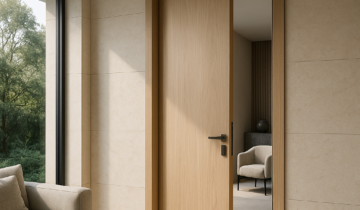
Wood veneer is often the most effective choice when a room needs warmth without visual noise. In warm minimalist spaces, the grain should feel refined rather than busy. Straight-grain oak, walnut, or similarly understated veneers tend to read as architectural rather than decorative. These finishes work especially well when the door aligns with cabinetry, millwork, or wall panels in the same tonal family.
If you want to explore how different door forms support this look, the luxury interior doors catalog is a useful place to compare surface treatments, silhouettes, and proportions.
When painted doors are the better choice
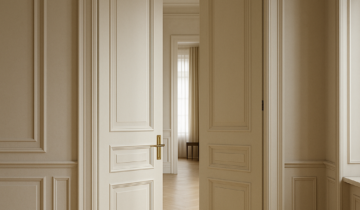
Painted doors are often the right answer when the design calls for calm continuity. A muted finish can blend the door into the wall plane, allowing materials and daylight to take the lead. This approach is especially effective in hallways, bedrooms, and open-plan interiors where too much contrast would break the rhythm of the space.
For a warmer result, avoid stark white unless the room is already very crisp and cool. Soft ivory, stone, greige, and dusty beige usually feel more aligned with the tonal subtlety that warm minimalism needs.
Let the wall and door relationship guide the decision
One of the most important questions is whether the door should disappear or stand out. In a warm minimalist home, the answer often depends on the wall treatment.
If the walls are smooth and quiet, a flush door finished in a similar tone can create a seamless architectural field. This is a strong strategy for spaces that rely on proportion and light rather than ornament. If the walls have texture, such as limewash, plaster, or ribbed paneling, the door finish should be calm enough not to fight that surface.
When the goal is visual continuity, concealed or nearly flush doors can be especially effective. For readers exploring contemporary systems, DAYORIS architectural door solutions offer a relevant reference point for how integrated door design can support a more seamless interior composition.
Choose contrast carefully
Contrast is not wrong in a warm minimalist interior, but it should be deliberate. A dark walnut door in a pale room can look elegant if the rest of the material palette is quiet and refined. Likewise, a lighter door can lift a darker envelope of walls and millwork. The key is scale: one strong gesture is enough.
Avoid using too many competing finishes. If the door is visually assertive, keep the hardware restrained. If the hardware is bold, let the door surface remain subdued. Warm minimalism is strongest when no single element overwhelms the others.
Hardware should belong to the same family
Hardware is often the detail that either completes the composition or exposes inconsistency. In a warm minimalist interior, the handle, hinge line, and latch should feel like part of the same design language as the door finish. Brushed bronze, muted black, and soft satin metals tend to read more naturally than high-polish surfaces.
Think of hardware as a connector rather than a feature. It should support the door’s proportion and finish, not turn it into a focal point. On flush doors especially, the handle becomes even more important because there is so little surface detail to absorb attention.
Match finish to use, not just to style
Different rooms benefit from different levels of visual emphasis. A primary suite may call for a richer veneer finish that adds intimacy, while a passage door in a hallway may need to recede into the background. Home offices, dressing rooms, and bathrooms often require a more careful balance between privacy and continuity, which makes finish selection especially important.
In these cases, the most successful interiors are rarely uniform from room to room. Instead, they maintain a consistent design language while adjusting tone, texture, and reflectivity according to function. That approach gives the home a sense of coherence without monotony.
Think in terms of light, not just color
Natural light changes how door finishes read throughout the day. A matte surface can soften bright daylight, while a satin veneer may bring subtle depth when the light is low. In narrow corridors or rooms with limited daylight, too much reflectivity can feel harsh. A quieter finish usually creates a better spatial experience.
Before finalizing a selection, compare samples in both daylight and evening light. The same door finish can feel warmer, cooler, flatter, or richer depending on the direction and quality of illumination. That small review often prevents costly design regret later.
When the door itself should be part of the architecture
In the most refined warm minimalist interiors, the door is not treated as a separate object. It becomes part of the wall composition, the circulation path, and the overall rhythm of the home. That is where proportion, edge detail, and finish all matter together.
Whether you choose a wood veneer, a painted surface, or a concealed flush profile, the goal is the same: let the door support the architecture rather than distract from it. If you want more editorial inspiration as you refine your direction, you can also browse more interior door design insights to compare finishes, styles, and spatial approaches.
Warm minimalist interiors feel successful when every surface appears considered, and interior doors are no exception. A well-chosen finish brings softness, continuity, and depth to the home, allowing the architecture to feel calm without becoming flat.