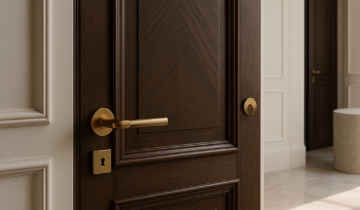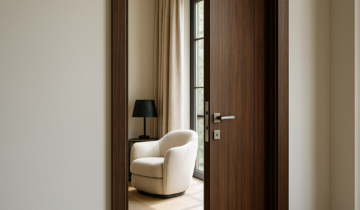
In a warm minimalist interior, every surface has to earn its place. That includes the doors. Because interior doors occupy so much visual territory, their finish can either support a calm architectural composition or interrupt it with unnecessary contrast. If you are deciding how to choose interior door finishes for warm minimalist interiors, the best place to start is not with the door style itself, but with the relationship between wall color, flooring, natural light, and the texture of the surrounding materials.
Warm minimalism is not about making everything look identical. It is about creating visual continuity through restrained contrast, soft material transitions, and a carefully edited palette. A door can disappear into the architecture, echo the tone of the walls, or introduce a quiet accent in wood, lacquer, or metal. The right choice depends on how much definition you want the opening to have and how the room is meant to feel as people move through it.
Why door finish matters in warm minimalist interiors
Doors are one of the few architectural elements that are constantly in motion. Unlike a wall, they open, close, frame views, and connect different rooms. In a warm minimalist home, a finish that feels too glossy, too dark, or too visually busy can make those transitions feel abrupt. A well-chosen finish, by contrast, helps the door participate in the larger rhythm of the interior.
This is especially important in open-plan homes, long corridors, and spaces where a door is visible from multiple angles. If the finish harmonizes with the wall surface, the composition feels quieter. If it complements flooring or millwork, the room gains depth without losing restraint. That balance is one reason many designers approach door selection as part of the overall interior architecture rather than a final decorative detail.
Start with the room’s dominant materials
Before choosing a finish, look at the strongest material cues already in the space. If the walls are limewash, plaster, or a warm matte paint, a soft lacquered door in a similar tonal family can maintain continuity without becoming flat. If the floor is walnut, oak, or travertine, the door can either repeat that warmth or step slightly lighter to create definition.
When the walls are soft and textured
Textured walls usually benefit from a quieter door surface. A matte lacquer in ivory, sand, mushroom, or warm taupe can preserve the tactile quality of the room without competing with it. In these settings, high sheen tends to feel too sharp. A low-reflective surface lets the wall texture remain the focal point while the door reads as part of the architecture.
When wood is already present in the room
If you are working with oak or walnut floors, cabinetry, or paneling, matching undertones becomes more important than exact color matching. A warm minimalist interior often looks more refined when wood finishes are related, not identical. A slightly lighter veneer can keep the room from feeling heavy, while a darker tone can ground the composition in a larger space.
Comparing the most effective finishes
Matte lacquer is one of the most versatile options for warm minimalism because it supports continuity and reduces visual noise. It works well when the goal is to create a seamless field of walls and openings, especially in contemporary residences where the door should recede rather than announce itself. For readers looking for broader inspiration, the Luxury Interior Doors blog offers additional editorial perspectives on architectural door design and interior transitions.
Wood veneer brings more material richness. In a warm minimalist setting, it introduces grain, depth, and subtle variation that can make a room feel more grounded. Veneer is particularly effective when the rest of the interior is very restrained, because it adds warmth without requiring ornament. The key is to keep the grain direction and finish level consistent with the overall design language.
Metal accents should be treated as part of the finish story, not an afterthought. Bronze, dark brass, and muted black hardware often work better than bright polished metals in warm minimalist interiors because they carry the same understated tone. When hardware, hinges, and pulls feel visually coordinated, the door reads as a single architectural element rather than a collection of separate parts.
Think in terms of proportion, not just color
Finish choice becomes even more important when the door has a stronger architectural presence, such as a full-height opening, a concealed frame, or a flush surface. In these cases, the finish determines whether the door blends into the wall plane or becomes a deliberate vertical feature. A restrained finish helps preserve scale, especially in rooms with tall ceilings or long sightlines.
For projects where wall integration is the goal, DAYORIS architectural door solutions can be a useful reference point for contemporary systems that emphasize visual continuity and clean transitions. You can explore their approach to custom interior door applications when evaluating how doors can support a more unified interior composition.
Common mistakes to avoid
One of the most common mistakes is mixing undertones without noticing them. A cool gray door next to a warm beige wall can feel slightly off even if each finish looks attractive on its own. Another frequent issue is using too much gloss in a room that depends on softness. Reflective finishes can make warm minimalism feel colder and more formal than intended.
It is also easy to overlook how a finish performs in transition spaces. A door that looks perfect in a bedroom may feel too faint in a hallway with less natural light, or too dark against bright plaster walls. Because of that, samples should always be reviewed in the actual room and at different times of day. The goal is not a perfect match in isolation, but a finish that supports the movement between spaces.
When selected carefully, an interior door finish becomes part of the atmosphere rather than a separate design decision. That is what makes warm minimalism successful: the room feels composed, calm, and materially coherent, with each opening contributing to the experience of the home instead of competing for attention. If you are comparing options for a renovation or new build, browse the catalog for design ideas or reach out through the contact page to discuss a project approach that fits your interior vision.