When a room depends on travertine, oak, plaster, and soft natural light, the door finish becomes part of the architecture rather than a decorative afterthought. Choosing the best door finish for warm minimalist interiors is really about balance: how a surface reflects light, how it relates to adjacent materials, and whether it quietly supports the room’s proportion or competes with it.
Start with undertone, not just color
In warm minimalist spaces, the most successful finishes are usually the ones that sit comfortably beside the room’s undertones. A creamy wall finish, for example, may feel slightly yellow, while a sand-colored stone leans neutral, and walnut brings a deeper amber note. If the door finish clashes with those undertones, the eye reads the mismatch immediately. If it aligns, the door feels integrated and the architecture appears calmer.
This is why a finish should not be selected in isolation. Place it next to flooring, wall paint, stone, and millwork samples whenever possible. A finish that looks perfect under bright showroom lighting may feel too cool, too glossy, or too heavy in a soft residential interior.
Matte, satin, or gloss: which finish works best?
For most warm minimalist interiors, matte and low-sheen finishes tend to be the most forgiving. They soften reflections, reduce visual noise, and help a flush or concealed door blend more naturally into the wall plane. That does not mean every door should disappear, only that the surface should support the room’s sense of calm.
Satin finishes can be a strong middle ground when you want a little more definition. They pick up daylight gently and can give a painted door or lacquered surface a refined depth without becoming shiny. High-gloss finishes are harder to use in this context because they introduce stronger reflections and a more polished, graphic character. In some interiors that contrast is intentional, but it is rarely the first choice for a warm minimalist palette.
Wood veneer, paint, and lacquer each create a different mood
Natural wood veneer
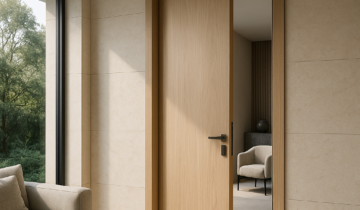
Walnut, oak, and similar wood veneers are often the most intuitive fit for warm minimalism because they add texture without visual clutter. A straight-grain veneer can feel architectural and restrained, especially when the door design is simple and the finish is understated. The result is warmth with discipline, which is exactly what many contemporary interiors need.
Painted and lacquered surfaces
Painted doors are useful when the goal is continuity. Matching the door to the wall color can make a hallway, bedroom, or office feel more expansive and composed. Lacquer can add subtle precision, especially when the design relies on clean lines and crisp edges. The key is to keep the color logic simple so the door becomes part of the architectural field rather than a separate object.
Metal accents and glass details
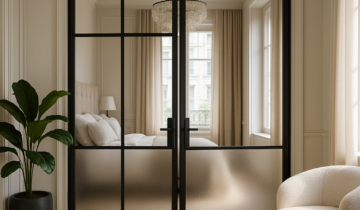
Small metal or glass details can enrich a minimal interior when they are used sparingly. Bronze hardware, smoked glass inserts, or a slim metal edge can add contrast, but the finish should remain disciplined. In a warm neutral room, too many competing materials can break the visual rhythm.
Should the door disappear or become a quiet feature?
That decision depends on the room and the architecture. A door finished to match the wall can create a nearly seamless transition, which works especially well in corridors, dressing rooms, and contemporary apartments where visual continuity is important. A door in a slightly deeper tone, such as walnut against limestone walls or a muted taupe against warm plaster, can become a subtle feature without disrupting the space.
The most effective approach is often one degree of contrast, not three. When the finish is too close but not exact, it can look accidental. When it is too different, it becomes the dominant element in the room.
Hardware should support the finish, not fight it
Warm minimalist interiors usually benefit from hardware that feels integrated and quiet. Bronze, blackened metal, and muted brushed finishes often work well because they reinforce the architectural line without drawing attention away from the surface. Overly bright chrome or decorative hardware can feel disconnected from the room’s material palette.
Consistency also matters. If the door finish is warm and tactile, the hardware should share that same restraint. A refined handle or concealed pull can be enough to complete the composition. For more design ideas and product context, the LuxuryInteriorDoors catalog is a useful place to study how finishes, profiles, and proportions are presented in contemporary interiors.
Room-by-room decisions make the finish feel intentional
In bedrooms, a softer finish often feels best because it supports rest and minimizes visual contrast. In home offices, a warmer matte surface can help the space feel grounded without becoming heavy. Hallways benefit from continuity, since they connect multiple rooms and set the tone for the rest of the interior. Bathrooms may call for more moisture-appropriate surface choices, but the same design logic applies: the door should belong to the room’s palette and not interrupt it.
When several doors appear in sequence, consistency becomes even more important. Repeating the same finish across adjoining spaces can make a home feel more composed and architecturally considered, especially in open-plan layouts and high-end renovations.
When a custom architectural solution is worth considering
Some interiors need more than a standard surface treatment. Full-height doors, concealed frames, wall-integrated panels, or unusual spatial conditions may require a more tailored approach so the finish aligns with the architecture cleanly. In those cases, it can be helpful to review the possibilities for DAYORIS custom interior door applications, especially when the goal is to maintain a consistent visual language across multiple rooms.
If the project is still in planning, it can also help to speak with a specialist early. You can use the contact page to begin a design conversation before finishes and hardware are locked in.
In warm minimalist interiors, the best door finish is rarely the most dramatic one. It is the finish that respects light, proportion, and material rhythm so the room feels calm from one threshold to the next.