In luxury residential design, concealed interior doors represent a sophisticated intersection of aesthetics, spatial fluidity, and functionality. Beyond their minimalist visual appeal, these architectural elements can play a crucial role in enhancing both privacy and acoustic comfort — two essential concerns in high-end interiors where quietude and intimate spaces are valued.
What Are Concealed Interior Doors?
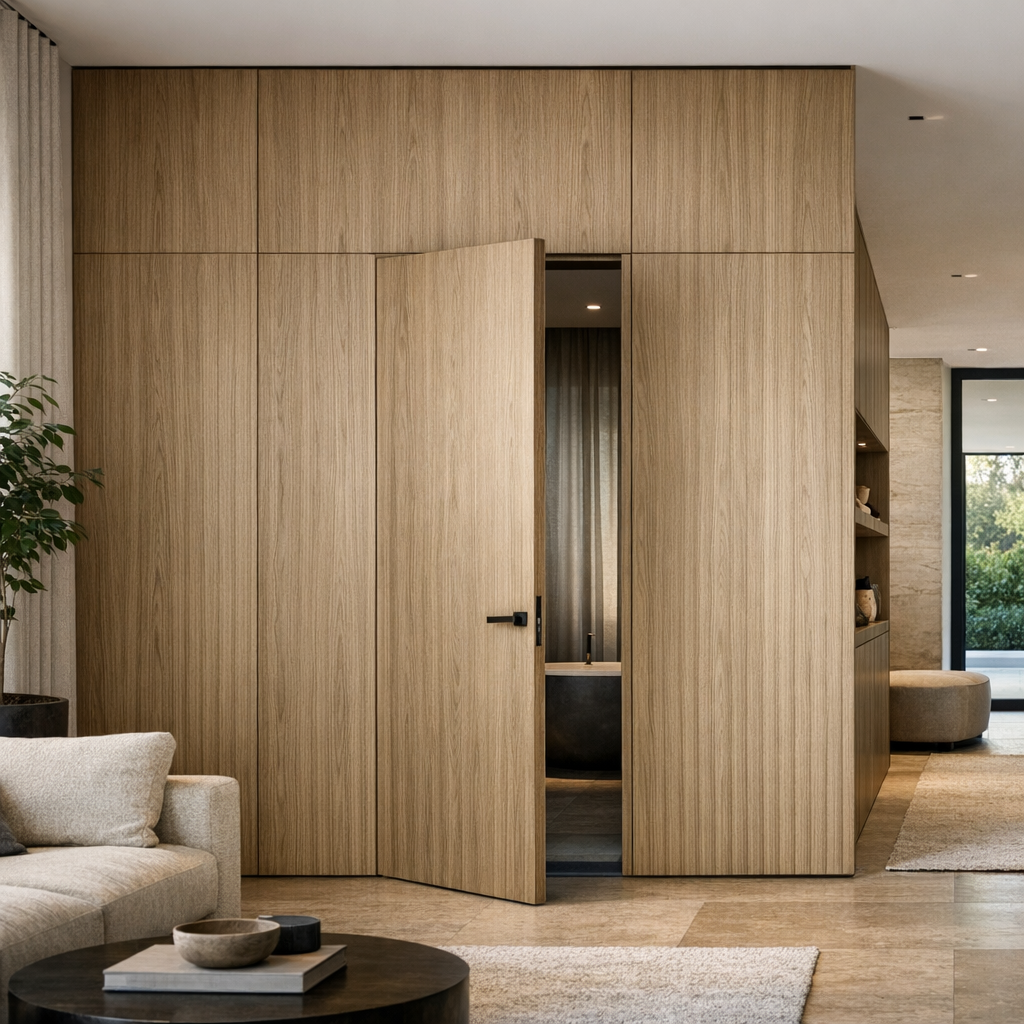
Unlike conventional doors that stand out as distinct design components, concealed interior doors seamlessly blend into surrounding walls or paneling to create uninterrupted visual continuity. Their hardware is typically hidden or minimized, surface finishes match adjacent wall textures, and door proportions often extend to floor-to-ceiling heights. This integration generates an elegant minimalism and spatial harmony common in contemporary luxury homes.
Privacy Challenges in Open, Minimalist Interiors
Modern luxury residences often embrace open floor plans and expansive glass walls to maximize natural light and spatial perception. While these architectural choices foster connectivity, they also raise questions of privacy and noise control:
- Sound transmission: Thin partitions and flush door systems may hinder effective acoustic separation.
- Visual privacy: Transparent or glazed surfaces sometimes compromise discrete zones such as bedrooms or home offices.
- Subtle transitions: Concealing doors too thoroughly may confuse spatial boundaries, affecting circulation and room identity.
Therefore, selecting concealed doors in these contexts requires a strategic approach focused on sound attenuation and deliberate spatial layering.
Acoustic Benefits of Concealed Interior Doors
Not all concealed doors are acoustically performant by default. But when designed and constructed with sound control in mind, they can significantly reduce noise transmission. Key architectural strategies include:
- Material layering: Incorporating dense core materials such as MDF, walnut veneers, or acoustic composites within the door leaf improves mass and sound dampening.
- Seal integrity: Precision-engineered concealed hinges and tight perimeter seals prevent sound leaks, preserving room privacy.
- Door thickness: Slightly thicker concealed doors can provide enhanced acoustic mass without visually disrupting flush aesthetics.
- Hardware choice: Specialized silent hinges and concealed closers contribute to noise reduction both during operation and in resting position.
Emerging architectural hardware solutions, such as those featured in modern door systems from DAYORIS, offer seamless integration of these acoustic features without compromising design.
Design Considerations for Privacy with Concealed Doors
Beyond acoustics, maintaining privacy involves spatial planning, lighting, and material coordination:
- Visual integration with subtle contrast: Doors that match wall finishes in texture and tone but incorporate a slight tonal shift or shadow gap help users identify openings without disrupting elegance.
- Proportion and scale: Floor-to-ceiling concealed doors reinforce verticality while creating subtle room delineations essential for privacy.
- Spatial zoning: Using concealed doors for bedrooms, studies, or bathrooms enhances discrete transitions between public and private areas.
- Complementary lighting: Integrated directional lighting or wall washers near concealed door edges can highlight entrances at night, preserving user orientation.
The Role of Materials and Finishes
Materiality profoundly influences both the aesthetic and performance characteristics of concealed doors. Popular choices include:
- Wood veneer finishes: Walnut, oak, and other fine woods provide natural warmth while contributing to sound absorption.
- Lacquered surfaces: Matt or satin lacquers ensure smooth, uniform textures that integrate with wall treatments.
- Acoustic laminates: Specialized layers engineered to improve sound dampening without altering visual appearance.
- Metal accents: Discreet bronze or brushed nickel hardware can add refinement while ensuring functional robustness.
The balance between tactile richness and minimalism is essential, supporting luxury interiors’ warm minimalist aesthetic.
Integration with Architectural Door Systems
High-end concealed doors increasingly rely on sophisticated door systems, such as pivot mechanisms and flush frame constructions, to meet demanding aesthetic and functional criteria. The benefits include:
- Smooth pivot movement: Eliminates projection typical of hinged doors, maintaining flush wall alignment.
- Concealed hardware: Hinges, locks, and closers are integrated into framing or leaf profiles, preserving clean sightlines.
- Custom sizing: Tailored dimensions align with architectural proportions and space programming.
Leading architectural door solution providers like DAYORIS specialize in made-to-measure systems optimized for these design challenges.
Common Installation Considerations and Pitfalls
When incorporating concealed interior doors with emphasis on privacy and acoustics, designers and homeowners should be mindful of:
- Precision installation: Gaps or misalignments can compromise acoustic seals and visual continuity.
- Wall construction compatibility: Stud wall types and panel thickness affect door framing options.
- Maintenance access: Concealed hardware may require specialized servicing methods.
- Lighting and wayfinding: In minimal spaces, ensuring door identification without glaring contrasts is essential.
Professional assessment from architects or specialized door system consultants helps mitigate these risks.
Conclusion
Concealed interior doors offer luxury residential designs a compelling solution for enhancing privacy and acoustic comfort without sacrificing the seamless elegance of minimalist interiors. Their careful specification—from materiality and finish to hardware integration and spatial planning—ensures a harmonious balance between form and function.
Exploring advanced architectural door systems such as those available from DAYORIS can further elevate concealed doors into integral elements of a refined spatial narrative.
For more inspiration on integrating luxury interior door solutions that prioritize both design and performance, visit our blog and browse our catalog.